> For the complete documentation index, see [llms.txt](https://blocksmd.gitbook.io/docs/llms.txt). Markdown versions of documentation pages are available by appending `.md` to page URLs; this page is available as [Markdown](https://blocksmd.gitbook.io/docs/email-input.md).
# Email input
Learn how to create an email input.
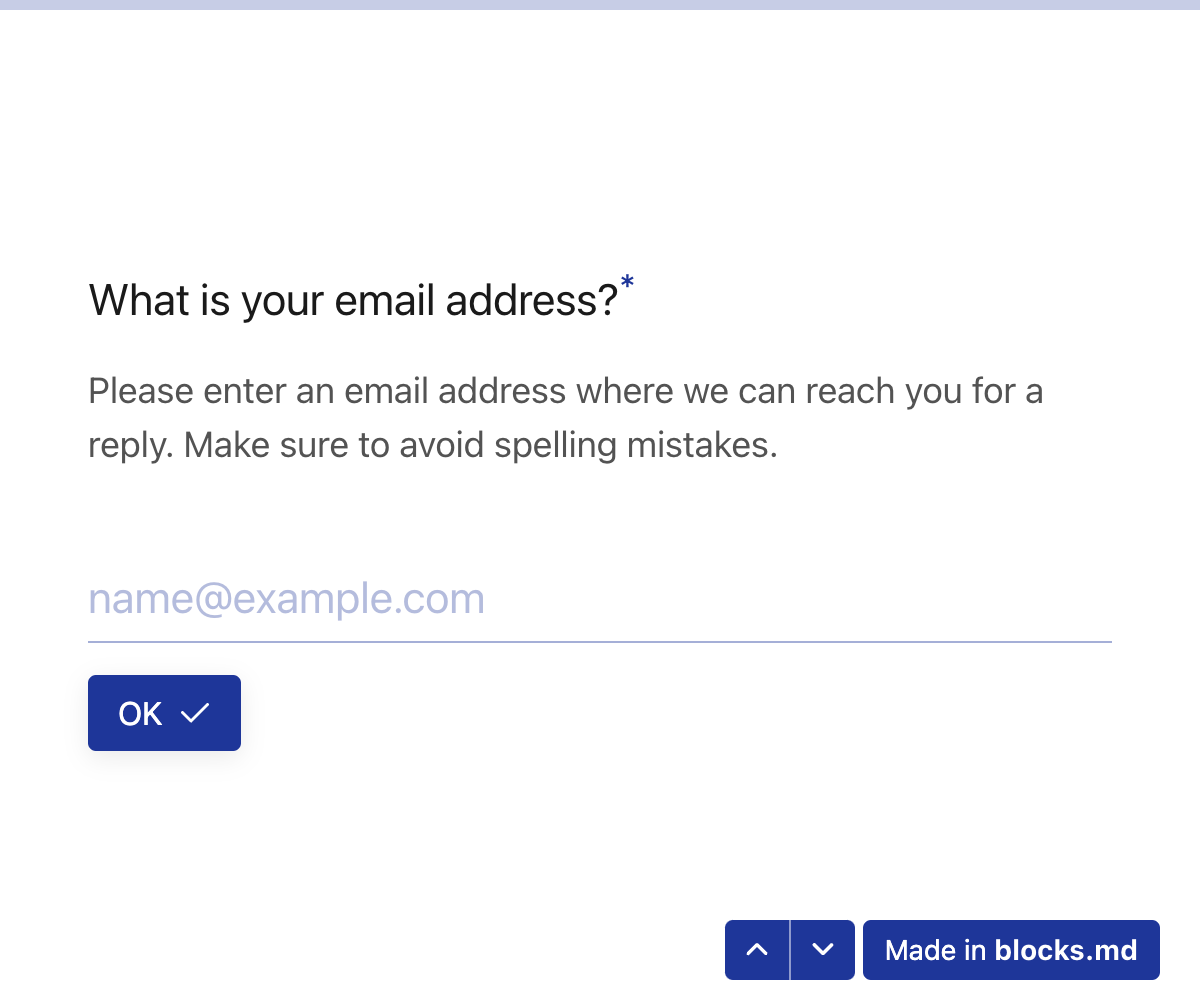
Email input
## Email input at a glance
Here's an email input with only the required parameter(s):
```
email = EmailInput(
| question = What is your email address?
)
```
Given below is another email input with all the available parameters. The **parameter names are case insensitive**, and the ones without values after `=` are **boolean parameters**. You can find details about all of them in the [available parameters section](#available-parameters).
```
email* = EmailInput(
| question = What is your email address?
| description = Some description
| fieldSize = sm
| subfield
| autofocus
| placeholder = Some placeholder text
| disabled
| maxlength = 255
| pattern = [a-zA-Z0-9\s]+
| value = Some value
)
```
## Basics of a form field
A form field is a **Markdown paragraph** in the following format:
```
{fieldName}{optionalAsterisk} = {fieldType}(
{parameters}
)
```
* The `{fieldName}` is the name of the input. It is used as the key for the value of the input in the form data (which is submitted as JSON). The `{fieldName}` can also be used to reference the input's value in the template. It must adhere to the following rules:
* Not start with a number
* Not contain a dash or hyphen (`-`)
* Not contain a space
* The `{optionalAsterisk}` is an `*` which (if provided) indicates that the field is required. If this is omitted, then the field becomes optional.
* The `{fieldType}` must be one of the following: `TextInput`, `EmailInput`, `TelInput`, `NumberInput`, `SelectBox`, `ChoiceInput`, `PictureChoice`, `RatingInput` or `OpinionScale` (case insensitive).
For example, here's a required email input form field with a class name added to the wrapping container:
```
[.col-6]
yourEmail* = EmailInput(
| question = What is your email address?
| description = Please make sure it's correct.
)
Your email is {$ yourEmail $}.
```
The following is not a valid form field because the empty line means that there are two Markdown paragraphs, and none of them follow the valid format:
```
address = TextInput(
| question = What is your address?
| description = ...
)
```
## Parameters
Parameters are information provided within the `(...)` when creating form fields. They must be separated by the `form-delimiter`, which by default is `|`. The `form-delimiter` can be [changed as a setting](/docs/settings.md#form-delimiter). For example, this would render the exact same email input from above:
```
#! form-delimiter = \\n
[.col-6]
yourEmail* = EmailInput(
question = What is your email address?
description = Please make sure it's correct.
)
Your email is {$ yourEmail $}.
```
Please note once again that parameter names are case insensitive, and boolean parameters only require their names to have effect (no need for values after `=`).
### Available parameters
The following parameters are available for email inputs:
#### `question`
The main question of the form field. Here, the question is placed inside the main `